
Homeopathy, Essential Oils, and Herbal Tinctures: What is the difference?

With so many ways to stay natural in your approach to healing, sometimes it's hard to narrow down which approach to take. I've found there's some confusion around these common methods: homeopathy, essential oils, and herbal tinctures. Here is a simple breakdown of the three in hopes of guiding you toward the right one!
Homeopathy
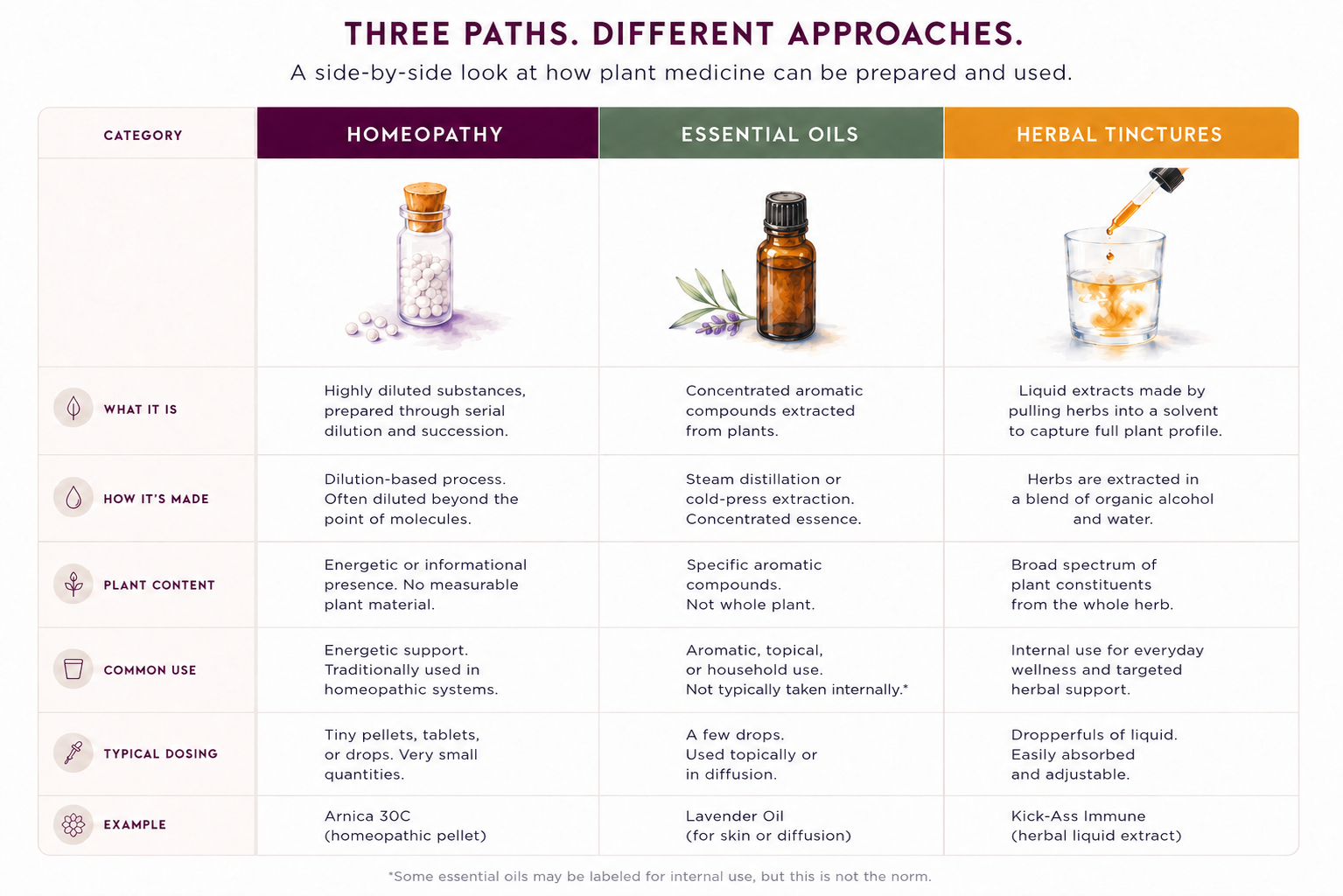
The concept of homeopathic medicine is fascinating. It was developed by German physician Dr. Samuel Hahnemann over 200 years ago. The word "homeopathy" is derived from two Greek words, "homeos," meaning similar, and "pathos," meaning suffering. This speaks to its approach of "like cures like." But what does that mean? In simple terms, homeopathy treats the ailment with plants, minerals, and other natural substances that produce a similar reaction in the body as the ailment itself. This may seem confusing. Why would someone prescribe a substance that would seemingly cause the same symptom you're trying to relieve? The belief is that our bodies, naturally and instinctively, can respond in the appropriate way, and that they heal with very little help from outside sources. When your body senses the substance, its natural defenses kick in, and the immune system does what it's made to do.
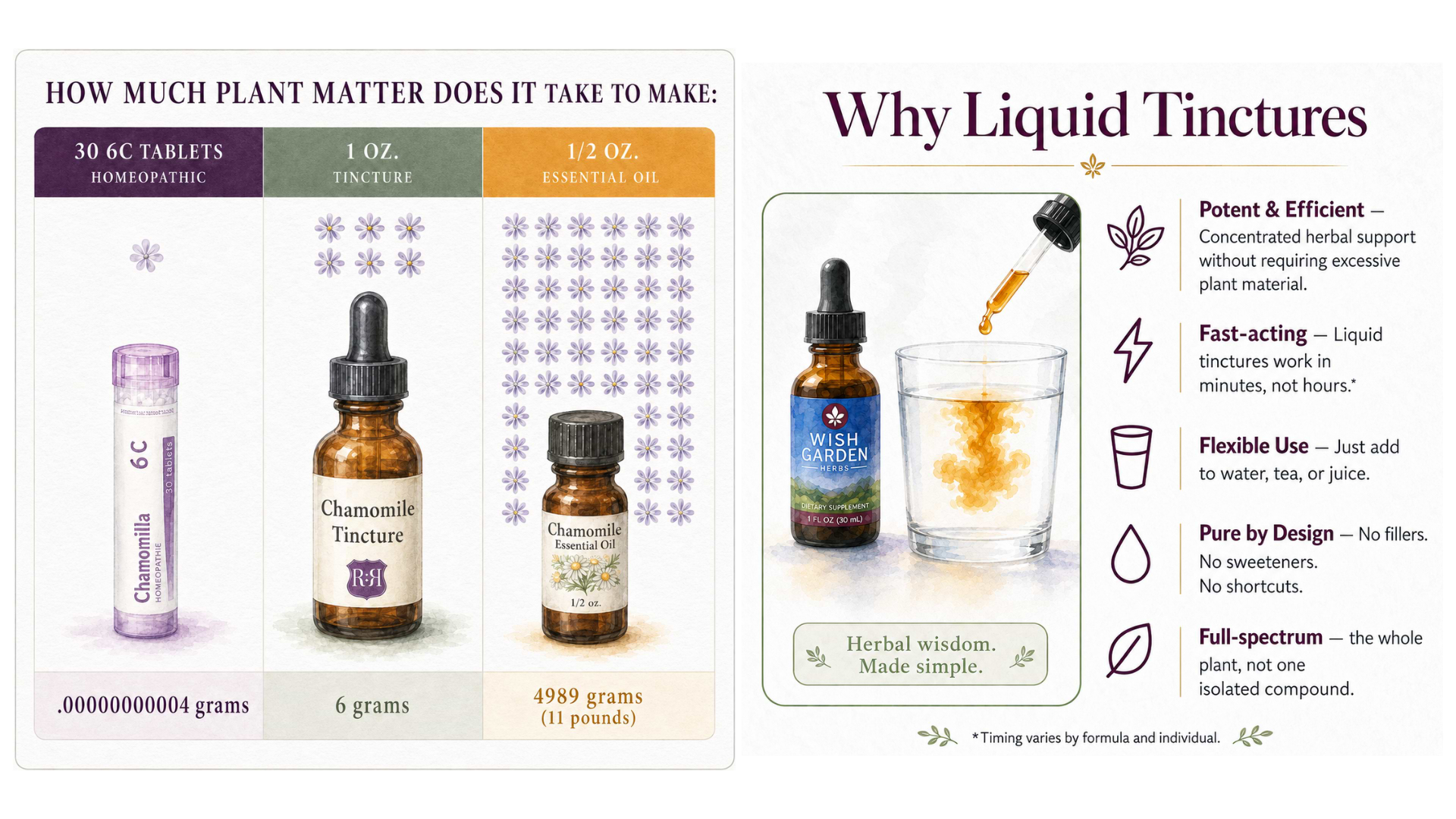
Homeopathic medicine is very diluted and contains very little of the plant, mineral, or other natural substance used. Some remedies are even diluted over a thousand times. For example, the process for plant sources could begin with a dilution of one part plant to nine parts alcohol and water. From there, potencies are diluted even further to a specific amount and then shaken vigorously (or succussed). The final product is meant to contain enough plant source for your body to sense the substance, but not enough to cause an over-reaction or toxicity. The dilutions are signified by a number followed by a letter such as X, C, or M. The number refers to the dilution and the letter refers to the ratio.
Homeopathic remedies may not be for everyone, but they've been safely used throughout history and can be a staple for those who have plant allergies or pharmaceutical sensitivities. Be sure to consult with a health practitioner when deciding which homeopathic remedy and dilution level is right for you.
Essential Oils
Some have argued that essential oils fall into the category of "phytopharmaceuticals." This is because essential oils aren't made from whole plant substances. They're highly concentrated and made by extracting the volatile oils from plants, leaving the rest of the constituents behind. Volatile oils are active, odorous constituents that vaporize readily, which is exactly why they're called "volatile." They're very strong, shouldn't be ingested, and need to be diluted properly when applied to the skin. Some essential oils can even break down skin tissue immediately upon contact.
When used appropriately, essential oils play a beautiful role in aromatherapy, massage therapy, and skin care. They're made by distillation, a process that evaporates and collects the volatile oils into a new liquid containing only that constituent. The amount of plant material needed varies widely. On average, 10,000 pounds of rose petals are needed to create one pound of essential oil, and 250 pounds of lavender are needed for the same. Because of these large quantities, sustainable sourcing matters even more, and it's something to keep in mind when choosing a brand. It's also worth remembering that oils come in different "grades," which depend on the duration of the distillation and play a major part in quality. When sourced responsibly and used safely, essential oils can make a great plant-based ally.
Liquid Herbal Tinctures
Herbal tinctures are simple by design. They're liquid extracts of medicinal plants, usually extracted in alcohol but also possible in vegetable glycerin and water. These liquids act as solvents that draw out the active constituents in plants. Vegetable glycerin and water can work as a substitute for those avoiding alcohol, and can also be used to dilute alcohol-based tinctures, reducing the final alcohol percentage.
The origin of herbal tinctures is largely disputed, but it's agreed they've been around for an extremely long time. Some believe herbal tinctures were created by Egyptian alchemists between 200 and 300 AD, since distillation is one of the seven stages of alchemy. Alchemy gained popularity in the Victorian era and is still referenced today, even in the era of modern medicine.
Herbal tinctures are whole plant remedies that maintain all of the active plant constituents. These constituents have an incredible ability to communicate with our bodies to support the healing and health of our various body systems. Tinctures are also a sustainable approach to natural medicine, as long as the herbs and plants are ethically sourced. To give an idea of scale, standard tinctures typically have a weight-to-volume ratio of 1:5. When preparing a tincture at home, many use the "folklore method," which is more intuitive and less exact. You'd fill a mason jar a third to halfway with medicinal herbs, roots, or berries, then pour 80- to 100-proof alcohol over the plant material and let it sit for at least three weeks. Strain out the plant material, and voilà, you have an herbal tincture. A tincture can be made from a single plant or a formulation of several plants working together to address a specific need. Some herbs work best as a "tonic," meaning they're used regularly and long-term. Others have a more powerful, fast-acting presence and work best for acute situations over shorter periods. Herbal tinctures are safe for many, but if you're pregnant, breastfeeding, or taking medications, talk to a health practitioner before starting an herbal remedy regimen.
See how tinctures stack up against gummies and capsules in Tinctures vs. Gummies and Capsules.
Why the Tincture Format Matters
Now that you understand the tincture format, here's how we actually make them work.
A tincture isn't just a delivery method; it's a decision about how plants get to communicate with your body. Because the liquid extraction process pulls out a wide range of a plant's constituents rather than isolating a single one, tinctures leave room for what herbalists call synergy: the way compounds within a single plant, or across several plants in one formula, work together in ways that a stripped-down extract simply can't replicate. This is part of why the solvent matters so much. Alcohol reaches constituents that water alone can't touch, which is a big part of what separates a well-made tincture from other formats. We go deeper on that science in Why Herbalists Use Alcohol in Tinctures.
You can also check out What is a Tincture? (Plus, Learn How to Make Your Own!) for more information and an easy DIY to follow.
This is also where formulation becomes an art. Blending herbs isn't about stacking ingredients for a longer label; it's about understanding how each plant's constituents interact with the others in the bottle, and with your body. It's a slower, more deliberate way to build a formula than most of the supplement industry bothers with.
If you want to go even further back, to how a tincture is actually made from raw plant material, What Is a Liquid Herbal Tincture? walks through the process start to finish.
References
- Britannica. "Samuel Hahnemann." https://www.britannica.com/biography/Samuel-Hahnemann
- AromaWeb. "Essential Oil Yields." https://www.aromaweb.com/articles/essential-oil-yields.php
- Southern Exposure Seed Exchange. "Herbal Tinctures: The Folk Method." https://blog.southernexposure.com/2022/11/herbal-tinctures-the-folk-method/
- Williamson, E.M. "Synergy and other interactions in phytomedicines." Phytomedicine, 2001. https://pubmed.ncbi.nlm.nih.gov/11695885/
- ScienceDirect Topics. "Tincture — an overview." https://www.sciencedirect.com/topics/pharmacology-toxicology-and-pharmaceutical-science/tincture
Rebecca Younger aspires to spark an interest in herbs within her community through education and incorporating herbs into everyday life in exciting and innovative ways. She studied herbal medicine at Herbalism Roots in Denver. She is a customer journey representative at WishGarden Herbs.
For educational purposes only. This information has not been evaluated by the Food and Drug Administration. This information is not intended to diagnose, treat, cure, or prevent any disease, or sell any product.