
Why Herbalists Use Alcohol in Tinctures: Curiosities & Concerns Answered
Have you ever wondered why some herbal tinctures contain alcohol? Or why alcohol is called "Spirits"? What decisions did our ancestors make (that we continue to make today) that led us to such a heavy reliance on this fermented substance to deliver what we once got in a simple cup of tea?
More to the point: is the alcohol in herbal tinctures harmful? How much is in there? What if I'm pregnant or nursing, can I still use my herbal tinctures? Is it safe for my kids to have tinctures? Can I give some to my dog? My cat? If I'm in recovery, does using herbal extracts with alcohol equate to losing my sobriety?
If you're someone who's concerned with what's in your food and beverages, the alcohol in herbal tinctures might cause even more alarm: What kind of alcohol is used? Is it organic? Is it GMO-free? Gluten-free? Processed in a facility with other allergens?
So. Many. Questions!
While we could spiral out or lose ourselves in internet searches, sometimes, to find the answers we're searching for, we have to uncover a foundation to start from. And when we're talking about alcohol, we have ancient roots to discover. For a deeper look at the philosophy behind our approach to plant medicine, check out our blog on Homeopathy, Essential Oils, and Herbal Tinctures: What is the difference?
So, let's take a moment and stand upon these roots steeped in ageless traditions and cultures that our ancestors discovered by communicating with nature. This language of antiquity still lives in many among us, and their wisdom holds the answers to both our curiosities and concerns about alcohol's role in tinctures.
How did people first begin using alcohol in tinctures?
Long ago, our herbalist forebears sought ways to extend the viability of their gathered herbs. Drying them, macerating them in water, heating them, and decocting (boiling) them were all sufficient ways to work with most fresh herbs and some dried herbs, too. But there were problems. The dried herbs lost potency. Maceration in water and even in vinegar led to putrefaction over time.
They needed a better way to preserve their medicines. They needed a miracle menstruum (a substance that dissolves a solid or holds it in suspension) that could withstand the test of time. That's where alcohol came in.
As they perfected the ratios of alcohol to water, early herbalists mastered the wildcrafting formulation that we know today as tinctures. Alcohol provided the gift of longevity and stability and eased the burdens of harvest. It also offered a more palatable delivery system, increasing a person's willingness to comply with the remedy offered. (Have you ever tried drinking a cup of decocted gentian root before a meal to enhance and support digestive processes? If not, try it. You'll soon see where "bitters" got their name!) Alcohol also made it possible to increase the dosage and strength of herbal remedies. And, not least of all, alcohol tinctures were much easier to store than a year's harvest of dried herbs.
Fast forward to our current go-go-go culture, and the bioavailability and convenience of having tinctures on hand in your car, purse, medicine cabinet, or desk drawer, wherever you roam, make it clear why tinctures revolutionized the herbal industry.
But alcohol is only one part of the extraction equation
Here's why we use three solvents.
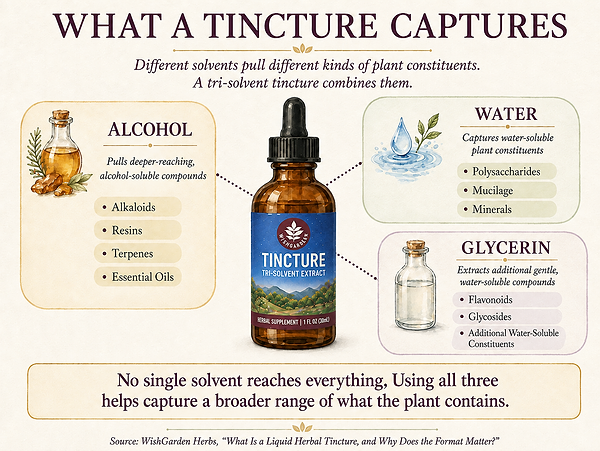
Alcohol earned its place in the herbalist's toolkit because it's an exceptional solvent, but it isn't the only one. Different solvents pull different kinds of plant constituents, and no single solvent reaches everything a plant has to offer. That's the thinking behind a tri-solvent extract.
Alcohol reaches deeper into the plant, pulling alcohol-soluble compounds like alkaloids, resins, terpenes, and essential oils, the constituents water simply can't access on its own. Water captures a different set of water-soluble constituents, including polysaccharides, mucilage, and minerals. Glycerin extracts additional gentle, water-soluble compounds like flavonoids and glycosides. Combined, the three solvents work together to capture a broader spectrum of what the plant contains than any one of them could alone.
This is part of why formulation matters as much as the herbs themselves. For a closer comparison of extraction methods and formats, including how liquid tinctures stack up against capsules, powders, and other delivery methods, see our blog on Herbal Tinctures, Gummies, and Capsules: What's the Difference?
Why is alcohol often called "Spirits"? Finding answers in alchemy
It must be noted, of course, that alcohol's roots are also heavily steeped in the gaiety of celebratory libations. Our ancestors were intent on crafting fermentations for the love of intoxication and the feeling of freedom that inhibition provides, but that story is for another day.
However, it does lead one to question why alcohol is so often called "Spirits." Is that where the term "free spirit" comes from? The simple answer is alchemy.
Alchemy. Sacred and transformative art. Mystical and powerful. Our alchemist ancestors witnessed how plants immersed in water were transformed by its solvent powers. The physical broke down, the life-force essence rose, and fermentation was born. Alchemists compared the fermentation process, this rising of a plant's essence, with the rising of our human spirits. And so, alcohol came to bear the name "Spirits."
How has our reliance on alcohol in tinctures not only survived but become the standard practice today?
In the early 1900s, an event took place that would solidify alcohol's place in the sacred art of wildcrafting herbal medicines.
In 1902, representatives from 12 countries representing "civilized pharmacopoeia" gathered in Belgium at the Conference Internationale pour l'Unification de la Formule des Medicaments Heroiques, establishing the standards of international protocol for "formulas for potent drugs," holding to using a menstruum of pure 190-proof (95%) ethyl alcohol for tincturing fresh plants. The protocols were ratified in 1906, cementing the practices that are now required for herbal tinctures.
Standards certainly have their benefits. They provide a basis of trust for the consumer, ensuring that wherever you purchase a tincture, the same set of safety and dosage standards are observed.
However, standardization also stripped herbalists of their ability to craft herbal remedies based on the ancient art of communion with the realm of plants. There was no place within the new standards for the wisdom of ancient lineages and their reverent communication with nature, nor the magic of alchemy. The new approach reduced the dynamic whole plant to its parts: tannins, resins, phenols, phenolic glycosides, coumarins, flavones, etc.
Luckily, the resurgence of herbalism in the Western world has been steadily and boldly uniting these roots of kinship with the realm of plants and the latest scientific standardization practices. A new form of alchemy has been birthed, one that respects the embodied wisdom and artful formulation of our lineages while employing scientifically proven methods of whole plant medicine.
Here at WishGarden Herbs, we recall our evolutionary steps side by side with plants. We unabashedly celebrate their ability to elicit our bodies', minds', and spirits' innate powers of health, healing, and vitality. We are alchemists who understand the needs of our changing world through the marriage of science and nature. We, too, have found gifts in utilizing alcohol as a menstruum, and we have done so by the intentional hand of our founder, Catherine Hunziker, who developed a low-tech and sustainable extraction art of formulation that uses alcohol to maximum benefit during the extracting phase while minimizing it in the finished product.
But what about safety? Is alcohol in tinctures harmful? Is ethyl alcohol organic?
First off, the quality of both the plants and the alcohol matters. Not all tinctures are created equal. Not all plants are honored, grown in healthy soil, and harvested with respect. That all matters a great deal. Think about it like this: if you're going to nosh on an apple born of insecticide-, pesticide-, and fungicide-laden orchard methods, picked prior to its ripening, and shipped halfway across the country before landing on your plate, how juicy and apple-like will it taste? Now compare that apple to a biodynamic or organic apple grown in harmony with the seasons and the hands that picked it. There's no contest! Herbal remedies are the same. Not all ethyl alcohol is organic. Not all herbs are grown organically or harvested sustainably. Your body knows the difference. And the same goes for GMOs, gluten, and other allergens. We do the research on all of our ingredients, including our alcohol extract.
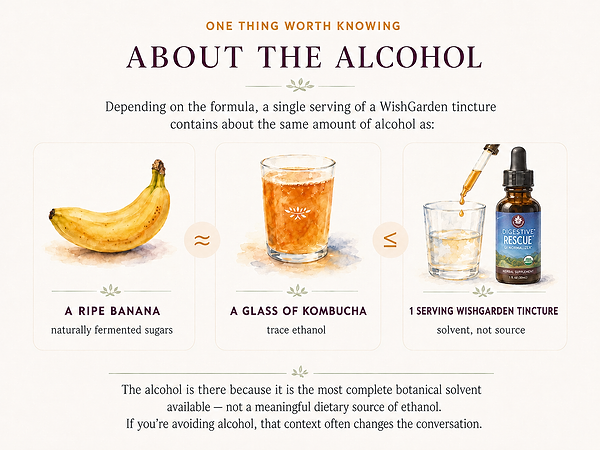
It's also worth putting the actual amount of alcohol into perspective. The alcohol in a tincture is there because it's the most complete botanical solvent available, not because it's meant to be a meaningful dietary source of ethanol.
Read more about WishGarden Herbs' methods.
The presence of alcohol in tinctures is safe when they are made within the standard protocols, wildcrafted by the hand and heart of an herbalist, and, most importantly, used in a manner that is specific to the individual's needs and desired outcomes. The herbal remedy you take and the dosage both matter. Always consult an herbal or natural therapies practitioner when you are unsure whether a certain tincture is right for you. Like WishGarden Herbs, many companies carry different formulations specific for children and pregnant or nursing mothers, as well as separate adult lines. Choosing a line that is appropriate to your age and phase of life is essential. The amount of alcohol in each varies.
And for the fur babes, although there is a method for safe consumption of some herbal extracts, we recommend consulting a veterinarian or herbalist who is trained in the ways of these remedies before giving your animals any tinctures.
Are tinctures made with alcohol safe for those in recovery?
For those who are in recovery or dealing with the sensitive matter of alcohol addiction, we see your strength and honor your process. We do not recommend that those in recovery use tinctures containing alcohol extracts to prevent even the smallest amount of alcohol from re-triggering any vulnerable or addictive pathways. Often it is not the volume or quantity of alcohol present that is relevant, but your personal engagement and sensitivity. Instead, we suggest making water extracts (such as teas and infusions) and powdered herbs your go-to herbal remedies. Again, please consult with your team, sponsor, and herbal or natural therapies practitioner before proceeding.
Wisdom of the ages, science of today
The use of alcohol as a menstruum for plant remedies is ancient. Its roots are varied and belong to every lineage on Earth. There are those who have furthered the wisdom of our elders and entwined the latest scientific methods to enhance the bioavailability of tinctures to assist our bodies' health and wellness.
Alcohol's presence in whole plant formulas is vital for the consistent extraction of constituents, as a preservative, and as a method to improve bioavailability, palatability, storage, dosage, administration, and compliance. And it offers us the convenience of a grab-and-go remedy, providing us with assistance from our plant allies exactly when we need it. Finally, as noted by those ancient alchemists, it enlivens within us our innate communion with nature, returning reverence and allowing gratitude to rise up from within each time we find support from our plant spirit remedies.
Want to go deeper on what a tincture actually is, and how to make your own at home? Check out What is a Tincture? (Plus, Learn How to Make Your Own!).
For the full foundational picture of why WishGarden formulates the way we do, visit our Why Liquid Tinctures hub.
For educational purposes only. This information has not been evaluated by the Food and Drug Administration. This information is not intended to diagnose, treat, cure, or prevent any disease, or to sell any product.
For educational purposes only. This information has not been evaluated by the Food and Drug Administration. This information is not intended to diagnose, treat, cure, or prevent any disease, or to sell any product.